From Surface to Visual Language
Why do human beings paint?
The question is perhaps even more fundamental than the history of painting itself.
Thousands of years before writing developed, people were already making images. They painted animals on cave walls, left impressions of their hands and recorded aspects of their world through marks, shapes and images.
Thousands of years have passed.
Cave walls gave way to wooden panels, canvas, paper and eventually digital screens. Pigments evolved. Oil paint, watercolour, acrylic and countless other materials expanded the possibilities of image-making.
Yet people never stopped painting.
Because painting is not simply a way of showing the world.
It is a way of expressing how we see it.
Painting is not simply copying reality
For centuries, one of painting’s major functions was to represent the visible world convincingly.
Human figures, landscapes, architecture, religious scenes and everyday life became central subjects.
Developments in perspective, anatomy, light and shadow allowed painters to create increasingly convincing representations of three-dimensional space on flat surfaces.
But painting was never simply a copy of reality.
An artist always makes choices.
What should be shown?
What should be excluded?
Where should the viewer stand?
Which moment should be represented?
Which colours should be used?
Should reality be altered?
Even the most realistic painting therefore contains the artist’s way of seeing.
Photography did not kill painting
The arrival of photography in the nineteenth century created a profound challenge.
If a machine could record reality with extraordinary detail, what was left for painters to do?
The answer did not lead to the death of painting.
Instead, it helped liberate it.
Artists increasingly moved away from simply recording what they saw and began exploring how they saw it.
Light could change.
Colour could move away from nature.
Figures could be distorted.
Perspective could collapse.
Eventually, recognisable objects could disappear altogether.
Painting expanded from the representation of the external world towards perception, memory, emotion and thought.
Impressionism: Capturing a moment
In the late nineteenth century, Impressionist painters began moving away from the strict conventions of academic painting.
Their aim was not necessarily to describe every object perfectly.
They became fascinated by light, atmosphere and temporary visual impressions.
A landscape looked different in the morning than in the evening.
Reflections on water could change within minutes.
Painting was no longer asking only:
“What is this?”
It was also asking:
“How does this appear at this particular moment?”
This shift became one of the foundations of modern painting.
Expressionism: From seeing to feeling
For other artists, the appearance of the external world became less important than the emotional experience of it.
In Expressionist painting, colours could move away from reality. Figures could become distorted and space deliberately unstable.
A green face was not necessarily a mistake.
A red sky did not mean the artist had failed to observe nature.
Reality could be transformed in order to communicate an internal state.
Painting became not only a language of sight, but a language of emotion.
Cubism: Seeing from more than one position
At the beginning of the twentieth century, Cubism radically challenged the perspective that had dominated Western painting for centuries.
Why should an object be shown from only one viewpoint?
Could a human face be seen from the front and the side simultaneously?
Cubist painters fragmented objects into geometric forms and brought different viewpoints together within the same composition.
The painting was no longer simply a window onto the world.
The canvas itself became an independent field of thought.
Abstraction: What remains when the object disappears?
This became one of the central questions of modern art.
If a painting contained no person, tree, house or recognisable object, could it still have meaning?
Abstract art demonstrated that it could.
Colour.
Line.
Rhythm.
Surface.
Texture.
Space.
Each could become a visual language in itself.
If music can affect us without representing a physical object, why should painting be unable to do the same?
Painting does not necessarily need to depict something in order to communicate.
Did figurative painting disappear?
No.
Despite the extraordinary development of abstraction during the twentieth century, the human figure never completely disappeared from painting.
Today, figurative painting is once again one of the most dynamic areas of contemporary art.
But contemporary figuration does not simply repeat the traditions of academic painting.
Artists may use the figure to explore:
identity,
the body,
gender,
memory,
migration,
isolation,
culture,
belonging,
and social relationships.
Figuration has not simply “returned.”
It never completely left.
Why does material matter?
How a painting is made can be as important as what it represents.
Oil paint allows long working times, layering and extraordinary depth of colour.
Acrylic dries quickly and can be applied to many different surfaces.
Watercolour creates a very different relationship between transparency, pigment and light.
Ink, pastel, tempera and other materials each create their own visual possibilities.
Contemporary painting has expanded these boundaries further.
Artists can combine paint with fabric, paper, photography, printing, digital imagery or found materials.
Painting no longer needs to be understood simply as pigment applied to canvas.
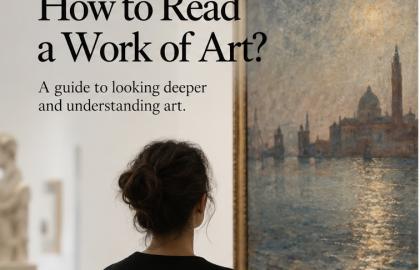
How should we look at a painting?
When we encounter a painting, identifying its subject is a natural first response.
“This is a portrait.”
“This is a landscape.”
“This is abstract.”
But that should only be the beginning.
How has the artist approached the subject?
How is colour used?
Can you see the brushstrokes?
Is the surface quiet or energetic?
Is the composition balanced?
How do the figures relate to one another?
How is empty space used?
And perhaps most importantly:
What changes when you spend more time looking?
A strong painting does not always reveal itself immediately.
Sometimes it asks us to return.
Is technical skill enough?
Technical ability matters.
But technical perfection alone does not necessarily produce significant art.
An artist may reproduce a face with photographic precision while saying very little beyond technical accomplishment.
Another artist may use only a few lines and areas of colour to create a powerful visual experience.
The important question is therefore not simply:
“How well was this made?”
We should also ask:
“Why was it made this way?”
Technique is a means through which artistic thought can become visible.
When technique becomes the entire purpose of the work, painting can easily become a demonstration of skill rather than an artistic proposition.
Why does painting survive in the digital age?
We now produce more images than at any previous moment in history.
We photograph our lives constantly.
Social media places thousands of images in front of us every day.
Artificial intelligence can generate new images within seconds.
And yet artists continue to stand in front of canvases and paint.
Perhaps this tells us something important about painting.
Digital images can be produced and consumed almost instantly.
Painting often requires time.
The artist’s time.
The material’s time.
The time required for paint to dry.
The time required to reconsider a decision.
And eventually, the viewer’s time.
This physical process gives painting a presence different from that of a purely digital image.
The surface of a painting does not merely contain an image.
It can also contain traces of the artist’s actions.
Why is seeing the original different?
Seeing an artwork on a screen and standing in front of the original are fundamentally different experiences.
Scale can disappear on a screen.
Texture can disappear.
The relationship between pigment and light changes.
A painting measuring more than a metre can be reduced to a few centimetres on a phone.
The purpose of digital art platforms should therefore not be to replace physical artworks.
Digital space can do something else:
It can make the first encounter possible.
A collector can discover an artist working in another country, explore their wider practice, follow their development and eventually encounter or acquire a physical work.
Technology, understood this way, does not have to compete with art.
It can reduce the distance between artist and viewer.
Painting in the 21st century
Contemporary painting cannot be explained through a single movement.
Figurative and abstract painting exist simultaneously.
Artists continue to work with traditional materials while responding to photography, cinema, digital culture, social media and artificial intelligence.
Local cultural traditions intersect with global visual culture.
An artist may live in Stockholm, carry cultural memories from Istanbul and have their work discovered by a collector in Tokyo.
This interconnected world creates the risk of visual homogenisation.
But it also creates opportunities for artists who once had limited access to traditional art institutions to build their own audiences.
Perhaps this is one of the most interesting aspects of painting today:
There is no single centre.
And there is no single correct way to paint.
THEARTE PERSPECTIVE
At Thearte, a painting is more than an object to be placed on a wall.
It represents a relationship between the artist’s thinking and the viewer’s experience.
For that relationship to develop, we need to see more than a single artwork.
Earlier works, recent paintings, recurring subjects, abandoned ideas and changing techniques can reveal the development of an artist’s individual visual language.
This is why an artist’s gallery on Thearte can be understood not merely as a place to display works, but as the artist’s visual memory.
Independent artists need spaces where this identity can develop and remain visible.
Many ideas that later transformed art history did not begin at the centre of established systems.
They emerged from artists willing to work beyond existing expectations.
The future of art will not be created only inside major institutions or established cultural centres.
It will also be created in studios across different cities, cultures and communities.
Thearte’s purpose is not to bring these artists under a single aesthetic.
It is to make them visible while allowing their differences to remain intact.
DISCOVER ART
Explore independent artists, their galleries and original artworks on Thearte.
For artists:
Create your personal gallery, bring together past and new works, develop your artistic identity and introduce your practice to an international audience.
For collectors and art lovers:
Discover new artists, explore their wider practice and find original works of art.
THEARTE
Independent Art. Independent Artists.
What is sculpture? Explore the evolution of sculpture from stone, marble and bronze to abstraction, public...
When we stand in front of a work of art, our first reaction is often immediate....