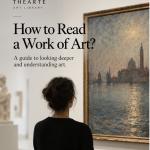
Looking at art is not the same as seeing it.
When we stand in front of a work of art, our first reaction is often immediate. We like it or we do not. It reminds us of something, makes us feel uncomfortable, attracts us, or perhaps leaves us indifferent.
But understanding art involves more than deciding whether something is beautiful.
To read a work of art is to consider its colour, form, material, composition and historical context — while also paying attention to the personal response it creates within us.
Art does not always give us a single answer.
Sometimes its greatest value lies in the questions it asks.
Start by looking
When you encounter a work of art, do not immediately try to explain it.
First, simply look.
Where does your eye go first?
To a figure? A particular colour? An empty space?
Then step back and look at the work as a whole.
You may begin to notice how the artist directs your attention. A strong colour, a source of light, a human face or even a large area of emptiness can guide the way we experience an image.
Your first reaction matters too.
Because art communicates not only through knowledge, but through perception.
Form and composition
Look at how the work has been constructed.
Where are the figures positioned?
Does the composition feel balanced, or deliberately unstable?
Is there a dominant element?
Does your eye move naturally across the work, or are you repeatedly drawn back to one particular point?
Composition can be understood as an invisible structure through which an artist guides the viewer’s gaze.
A portrait with a face placed directly in the centre creates a different psychological effect from one in which the figure is pushed towards the edge.
Likewise, a large empty space may suggest silence, distance, isolation or anticipation.
Do not look only at what appears in an artwork.
Consider where and how it appears.
Colour is never just colour
Colour is one of art’s most powerful languages.
Red may suggest energy, danger, love or anger. Blue may create feelings of calm, distance or melancholy.
Yet colours do not have fixed meanings.
What matters is how the artist uses them.
Ask yourself:
Which colours dominate the work?
Are they naturalistic, or has the artist deliberately moved away from reality?
Do the colours harmonise or create tension?
A human face painted in green, violet or intense red is not simply an unusual technical choice. Colour can transform the psychological atmosphere of an image.
Sometimes colour tells us more than the subject itself.
Look at the material
One way to understand an artwork is to consider how it was made.
Oil paint and watercolour do not behave in the same way.
Neither do marble and wood, bronze and textile.
Thick layers of paint can create a physical, almost sculptural surface, while thin transparent layers may produce a quieter and more fragile atmosphere.
Contemporary artists have expanded these possibilities even further.
Earth, fabric, metal, plastic, video, light, sound and ordinary objects can all become artistic materials.
This leads to an important question:
Why might the artist have chosen this particular material?
Subject and meaning are not the same thing
Identifying what an artwork depicts is often relatively easy.
A woman.
A landscape.
A house.
A city.
An animal.
But these are only the visible subjects.
The more interesting question is:
What is the artist exploring through that subject?
A landscape may not simply be about nature. It may deal with memory, belonging, loss or isolation.
A portrait may not merely record someone’s appearance. It may explore identity, power, ageing or social roles.
Reading art means moving from the visible object towards the ideas that may exist behind it.
Get to know the artist
You do not need to know an artist’s entire biography to understand an artwork.
But knowing something about the artist can open new ways of seeing.
Where and when did they work?
What cultural environment shaped them?
Are there subjects or visual elements that repeatedly appear in their work?
When you look at several works by the same artist, certain colours, figures, materials or ideas may begin to recur.
A single work can appear isolated.
Placed alongside an artist’s wider practice, it may become part of a much larger story.
One of the best ways to understand an artist is therefore not to look only at their most famous work, but at the development of their work over time.
Consider when it was made
Art is not created in a vacuum.
Every artwork emerges from a particular historical, social and cultural environment.
Understanding what was happening when a work was created can fundamentally change the way we see it.
War, migration, technological change, economic crises and shifts in society can all influence artistic production.
Context, however, does not mean that an artwork has only one correct interpretation.
History opens another door.
It does not explain everything for us.
Ask what it makes you feel
We sometimes imagine that personal feelings should be excluded when we look seriously at art.
Yet the viewer’s experience is an essential part of the encounter.
If a work makes you uncomfortable, ask why.
If it reminds you of childhood, consider which element created that connection.
Even when you dislike an artwork, you can ask:
Why don’t I like it?
Sometimes that question can be more revealing than asking why we love something.
Understanding art does not require us to like everything we see.
The artist’s intention is not everything
An artist may begin with a specific idea.
But once an artwork leaves the studio, it enters the lives of other people.
Every viewer approaches it with different experiences, knowledge and memories.
The same artwork can therefore create different meanings for different people.
This does not mean that every interpretation is equally convincing.
There is a difference between interpretation and arbitrary assumption.
A strong interpretation can usually be connected to something visible within the work: colour, form, material, composition or context.
The artwork itself provides the evidence.
Separate price from artistic value
A high market price does not automatically make something a great work of art.
Likewise, an affordable work by an emerging or independent artist is not artistically insignificant simply because the artist has not yet become widely known.
Prices in the art market can be influenced by many factors: an artist’s exhibition history, gallery representation, collector demand, rarity, size, date and broader market conditions.
Artistic value asks different questions.
Does the work contain an original idea?
Is the artist developing a recognisable visual language?
Do technique and concept support one another?
Does the work have meaning within the artist’s wider practice?
Looking at art only through its price risks missing much of what makes it interesting.
How much knowledge do you need to understand art?
Sometimes very little.
Sometimes years.
Knowledge of art history can certainly deepen our understanding, but you do not need to be an art historian to develop a meaningful relationship with art.
Curiosity is enough to begin.
Spend longer with an artwork.
Look at its details.
Discover the artist.
Question your first reaction.
Over time, the way you see begins to change.
The more we look at art, the more we learn to see.
And the more carefully we see, the more we begin to notice.
Sometimes an artwork we once walked past without a second thought can speak to us completely differently years later.
THEARTE PERSPECTIVE
At Thearte, discovering an artwork means more than seeing a single image.
It means discovering the artist, their practice and the visual language they develop over time.
An artist’s personal gallery should therefore be more than a digital display of individual works.
It can become the artist’s visual memory.
Earlier works, new experiments, recurring themes, changing techniques and different periods of production together reveal something that no single artwork can fully communicate:
the identity of the artist.
This is why creating an independent space for artists matters.
Art is not created only to be displayed.
It is created to be seen, understood, remembered and experienced by others.
DISCOVER ART
Explore independent artists, personal galleries and original artworks on Thearte.
For artists: Build your gallery, bring your work together and introduce your artistic practice to an international audience.
For collectors and art lovers: Discover artists, explore their galleries and encounter original works from different places and perspectives.
THEARTE
Independent Art. Independent Artists.
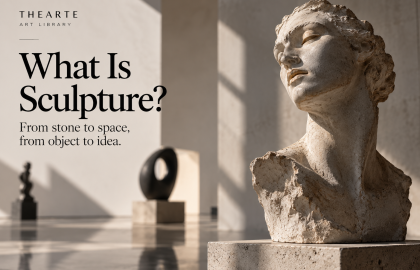
What is sculpture? Explore the evolution of sculpture from stone, marble and bronze to abstraction, public...
Explore the development of painting from representation and Impressionism to Cubism, abstraction, contemporary figuration and painting...