For much of Western art history, Black figures were either excluded from painting or reduced to marginal roles.
The work of Kerry James Marshall confronts this absence directly.
Over the last fifteen years, Marshall has become one of the most influential painters of the contemporary era by placing Black life, history, and presence at the very center of large-scale, historically informed paintings. His work challenges not only what is represented in art, but who has the authority to be visible within its canon.
Marshall’s paintings combine references to European art history with scenes drawn from everyday Black experience. This deliberate tension exposes the exclusions built into traditional narratives of painting, while asserting that Black subjects belong fully — and unapologetically — within the history of art.

Kerry James Marshall demonstrates that painting is not neutral. It is a space where power, history, and visibility are negotiated — and reimagined.
Painting, Visibility, And The Politics Of Representation
Painting has always played a central role in shaping cultural memory, yet it has also been a site of exclusion. For centuries, Western painting largely ignored Black presence or relegated it to the margins. Kerry James Marshall’s work emerges from a direct confrontation with this absence. Over the past fifteen years, his paintings have reshaped contemporary discussions around representation, visibility, and historical authority, proving that painting remains a powerful political and intellectual medium.
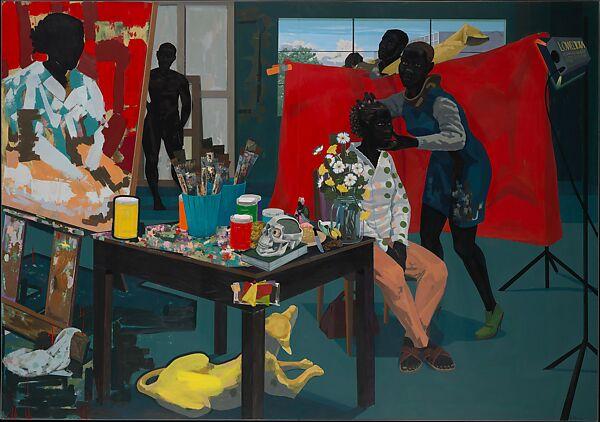
Marshall’s project is not simply to add Black figures to existing visual traditions. Rather, he questions the very structure of art history itself. His paintings deliberately adopt the scale, composition, and ambition traditionally reserved for grand historical subjects. By doing so, he claims space within the canon while simultaneously exposing its limitations. The presence of Black bodies in his work is not symbolic or decorative; it is structural. These figures occupy the center of the image, asserting their right to be seen, remembered, and monumentalized.
A defining feature of Marshall’s paintings is his use of deep, matte black skin tones. This choice is both aesthetic and conceptual. Against richly detailed backgrounds, the figures resist visual assimilation, challenging conventions of lighting and form developed around white subjects. In doing so, Marshall forces viewers to confront how painting itself has been historically coded. Seeing, in his work, becomes an active and sometimes uncomfortable process.
Marshall’s engagement with everyday life is equally important. His scenes often depict parks, housing projects, classrooms, and domestic interiors — spaces rarely celebrated in traditional painting. Yet these environments are rendered with complexity, care, and historical awareness. The paintings balance joy and tension, intimacy and critique. They resist simplified narratives of struggle or celebration, presenting Black life as layered, ordinary, and deeply human.
Art history is a constant presence in Marshall’s work. References to Renaissance composition, Baroque structure, and modernist color theory appear throughout his paintings. However, these references are never acts of imitation. Instead, they function as tools of reclamation. By mastering the visual language of Western painting, Marshall exposes its exclusions and reclaims its authority from within.
What makes Kerry James Marshall especially influential in the contemporary moment is his insistence that representation is inseparable from power. In an era increasingly concerned with diversity and inclusion, his work avoids superficial gestures. Painting, for Marshall, is not a platform for slogans but a slow, demanding process of rewriting visual history. His paintings require sustained attention and reward it with complexity.
Marshall’s impact can be felt across a new generation of figurative painters who engage with identity, history, and visibility. He has demonstrated that painting can still operate at the highest intellectual level while addressing urgent social questions. In doing so, he has expanded both the possibilities of contemporary painting and the boundaries of art history itself.
Ultimately, Kerry James Marshall’s work affirms that painting remains a site of struggle — over who is seen, who is remembered, and whose stories are considered worthy of representation. His paintings do not ask for inclusion; they assert presence. In a contemporary art world saturated with images, Marshall rem inds us that visibility, when claimed with precision and depth, can still be transformative.