In an age dominated by digital images, instant visibility, and endless reproduction, painting is often questioned: Does it still matter?
The work of Gerhard Richter offers one of the most convincing answers to this question.
Over the last fifteen years, Richter has remained a central figure in contemporary painting by refusing certainty. His work moves between blurred photographic images and large-scale abstraction, not to offer clear meaning, but to expose the instability of images themselves. Rather than confirming what we see, Richter’s paintings ask us to doubt it.
This skepticism is precisely what makes his work so relevant today. In a world overwhelmed by visual information, Richter slows the act of looking down. His paintings demand time, attention, and reflection — qualities increasingly rare in contemporary image culture.

Gerhard Richter proves that painting does not need to compete with digital media. Its strength lies in doubt, slowness, and ambiguity — qualities that allow images to remain meaningful in an age of excess visibility.
Why Painting Still Matters In The Digital Age
Painting today exists under constant pressure. Images circulate faster than ever, clarity is expected, and meaning is often reduced to instant impact. Against this backdrop, Gerhard Richter’s work feels deliberately slow and resistant. For more than sixty years — and with renewed relevance over the last fifteen — Richter has questioned the authority of images rather than reinforcing it. His paintings do not offer answers; they create space for doubt.
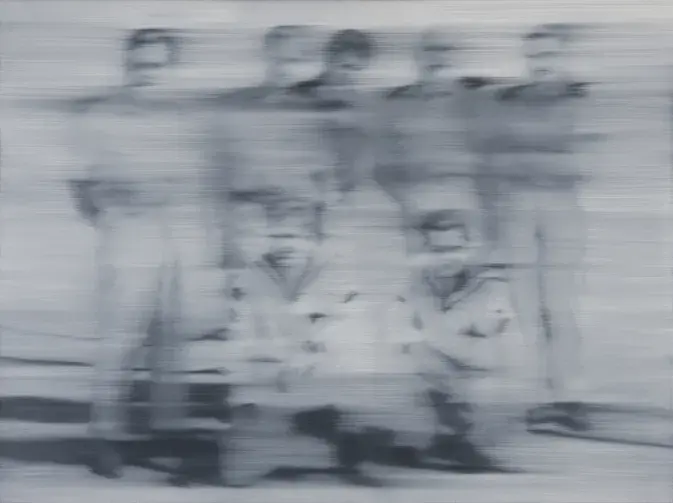
Richter’s blurred photo-based paintings are central to this approach. Working from photographs taken from newspapers, personal archives, and historical sources, he transforms images associated with documentation into uncertain visual fields. By softening edges and dissolving detail, Richter undermines photography’s claim to objectivity. What remains is not clarity, but distance. These works resemble memory itself: incomplete, unstable, and shaped by time rather than accuracy.
This strategy is particularly significant in relation to history. Richter’s engagement with Germany’s postwar past avoids direct narrative or explicit judgment. Instead of illustrating trauma, his paintings acknowledge the limits of representation. They suggest that some histories cannot be fully shown — only approached cautiously. In this way, painting becomes an ethical space, one that respects complexity rather than simplifying it.
Alongside these figurative works, Richter’s abstract paintings play an equally important role. Created through layered applications of paint using large squeegees, these works balance control and chance. The surfaces are built, erased, and rebuilt, revealing traces of process rather than expressive gesture. Abstraction here is not emotional release, but visual thinking. It reflects uncertainty, instability, and the impossibility of fixed meaning.
What makes Richter especially influential in recent years is his refusal to align painting with certainty — whether political, emotional, or visual. At a time when images are expected to communicate quickly and clearly, his work insists on hesitation. This position has shaped a generation of contemporary painters who move between figuration and abstraction without committing to either as a final truth.
Richter’s importance lies not in style but in attitude. He treats painting as a critical practice — one that questions images rather than producing more of them. In a culture saturated with visibility, his work reminds us that meaning often emerges not from clarity, but from restraint.
Ultimately, Gerhard Richter shows that painting still matters precisely because it cannot be reduced to speed or certainty. His work demonstrates that slowness, doubt, and ambiguity are not weaknesses, but essential tools for understanding a complex world.