Being an Artist in the Age of AI: Threat or Opportunity?
A few years ago, the idea of typing a sentence and watching an image bloom into existence felt like science fiction. Today, it's a Tuesday afternoon. AI image generators, style transfer tools, and generative video are no longer novelties — they're part of the everyday toolkit for millions of creators. And with that shift has come one of the most heated debates in the art world: is artificial intelligence a threat to artists, or the biggest creative opportunity in a generation?
The honest answer is that it's both — and understanding why is more useful than picking a side.
How We Got Here
It's worth remembering how fast this all happened. Just a handful of years ago, AI-generated images were blurry, uncanny, and easy to spot at a glance — six-fingered hands, melted faces, warped text. Today's models produce results that can pass for professional illustration, photography, or concept art in seconds. Video generation, once a much harder problem, has followed the same curve: tools that struggled with basic motion consistency now produce coherent, stylized clips that artists use for animatics, mood pieces, and even finished content.
This speed of change is precisely what makes the conversation feel so urgent. Artists aren't just adapting to a new tool — they're adapting to a tool that keeps changing shape every few months, which makes it hard to settle into a stable relationship with it, whether that relationship is adoption, resistance, or something in between.
The Case for Threat
The fear is not irrational. AI models are trained on vast datasets scraped from the internet, often including copyrighted artwork used without consent or compensation. Many illustrators, concept artists, and photographers have watched their distinctive styles get mimicked by prompts in seconds — work that once took years to develop as a signature. Commercial clients who previously hired artists for quick turnaround projects — book covers, marketing assets, concept sketches — increasingly turn to AI generation instead, cutting into a segment of the market that many working artists relied on to pay bills between larger projects.
This isn't limited to visual art, either. Musicians face AI voice cloning and style-matching models. Writers face text generators that can mimic tone and structure. Animators face tools that can inbetween, lip-sync, or even fully generate character motion from a handful of reference frames. The pattern is consistent across disciplines: the tasks that used to be time-consuming enough to justify a professional fee are the first to be automated.
There's also a deeper, more existential worry. Art has always been partly about scarcity and skill — the years of practice behind a confident brushstroke, the trained eye behind a well-composed frame. When a machine can approximate that in seconds, it can feel like it cheapens the value of the craft itself, or at least changes what audiences are willing to pay for. For early-career artists especially, this raises a hard question: if the entry-level jobs that used to build a portfolio and a client base are the ones AI does best, how does the next generation of professional artists get started at all?
The Case for Opportunity
At the same time, tools reshape practices without necessarily replacing them — and history offers some perspective here. Photography was once feared as the death of painting. Digital tools were feared as the death of traditional media. Drum machines were feared as the death of live musicianship. In every case, the art form didn't disappear; it evolved, and new creative disciplines emerged alongside the old ones, often more accessible than what came before.
Many artists are already integrating AI into their process rather than being replaced by it — using it to rapidly prototype compositions, generate reference material, explore color palettes, or break through creative block, while keeping their own hand and judgment central to the final piece. Some illustrators use generative tools the way earlier generations used photo references or maquette models: as a starting point to react to, not a finished product to ship. Animators experimenting with AI video tools have found that fine-tuning motion, timing, and physical behavior — hair movement, cloth dynamics, character weight — still requires real craft and iteration; the tool gets you a rough draft faster, but shaping it into something expressive is still a human skill.
For independent creators, AI-assisted workflows can also lower the barrier to producing polished portfolios, marketing materials, or animated content that once required a full team and budget. A solo illustrator can now mock up a full visual pitch deck in an afternoon. A small studio can previsualize an entire scene before committing to expensive production time. This doesn't eliminate the need for skilled artists — but it does change who gets to participate in high-production-value work in the first place.
New creative roles are emerging too: prompt engineers, AI art directors, and hybrid artists who blend traditional technique with generative tools to create work that neither a human alone nor an AI alone could produce. Some artists are even building entirely new visual languages by treating AI as a collaborator rather than a competitor — running dozens of generations, selecting fragments, compositing, painting over the output, and repeating the cycle until something genuinely new emerges. That kind of process is its own discipline, with its own learning curve and its own aesthetic sensibility.
What Actually Matters Now
The threat-or-opportunity framing, while useful for a headline, oversimplifies a more nuanced reality. What's really at stake is:
Practical Ground for Artists Right Now
For working and aspiring artists trying to navigate this without a clear roadmap, a few grounded approaches tend to hold up:
So, Threat or Opportunity?
Perhaps the most honest answer is that AI is a mirror — it amplifies whatever an artist already brings to the table. For those who see their identity purely in technical execution, it can feel deeply threatening. For those who see their identity in vision, curation, and storytelling, it can be a remarkably powerful extension of the hand.
The artists who will thrive in this new landscape won't be the ones who resist the tools entirely, nor the ones who let the tools do all the thinking. They'll be the ones who stay curious, keep asking hard questions about ethics and ownership, and use every tool available — old and new — in service of a vision only they could have.
The age of AI hasn't ended what it means to be an artist. It's asking artists to define it again.

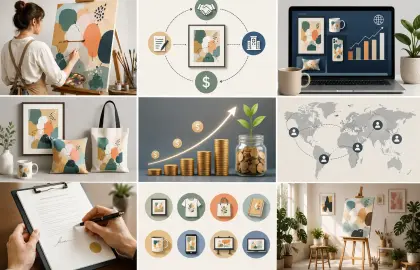
Learn how artwork licensing works, how artists earn royalties, where to license their work, and how...
What should you consider when buying art for the first time? Learn about authenticity, artist research,...
Who buys artwork today? Discover the different types of art buyers, from collectors and interior designers...